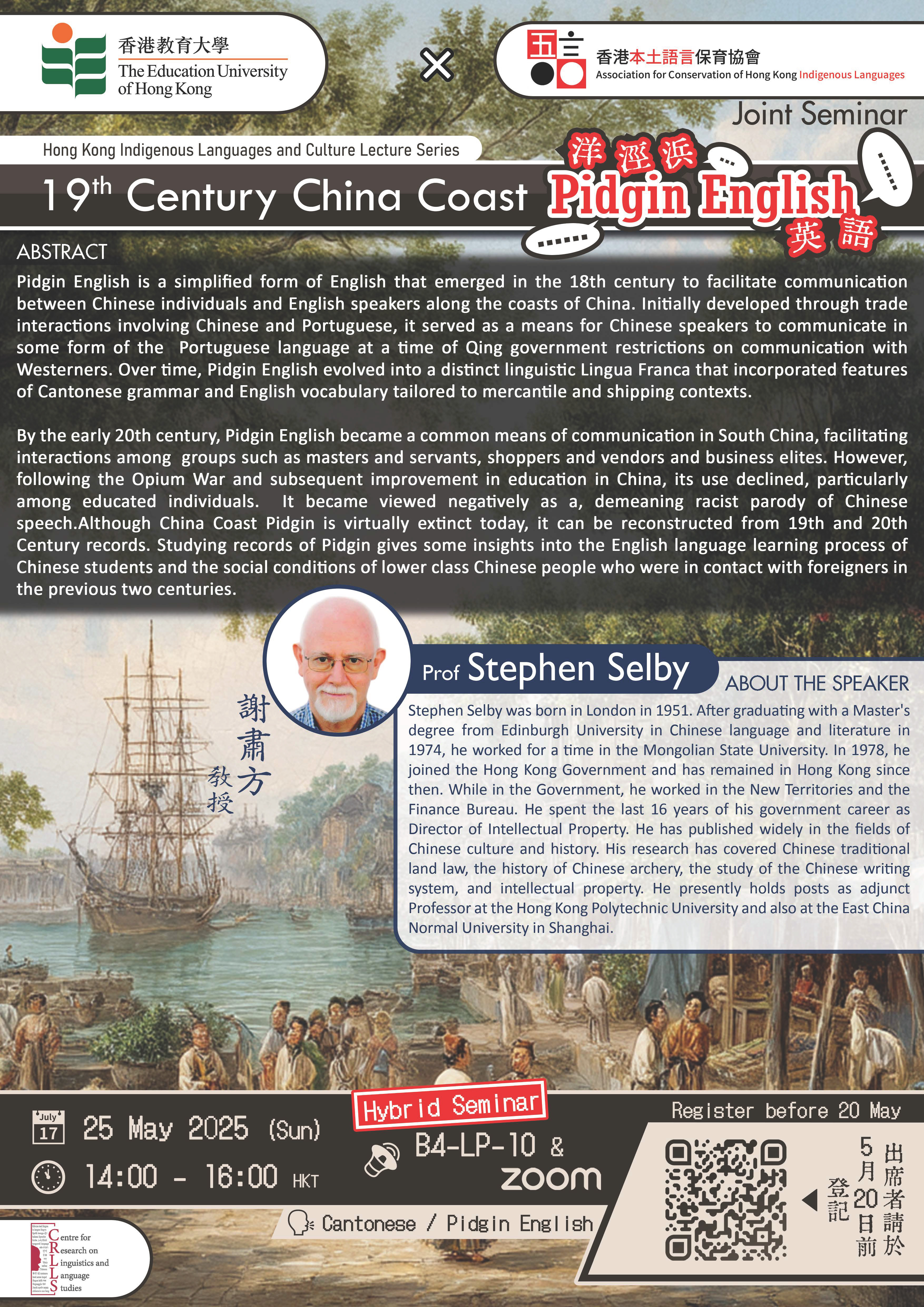
19th Century China Coast Pidgin English
十九世紀濱海英語——消失的華南通用語
About the Event
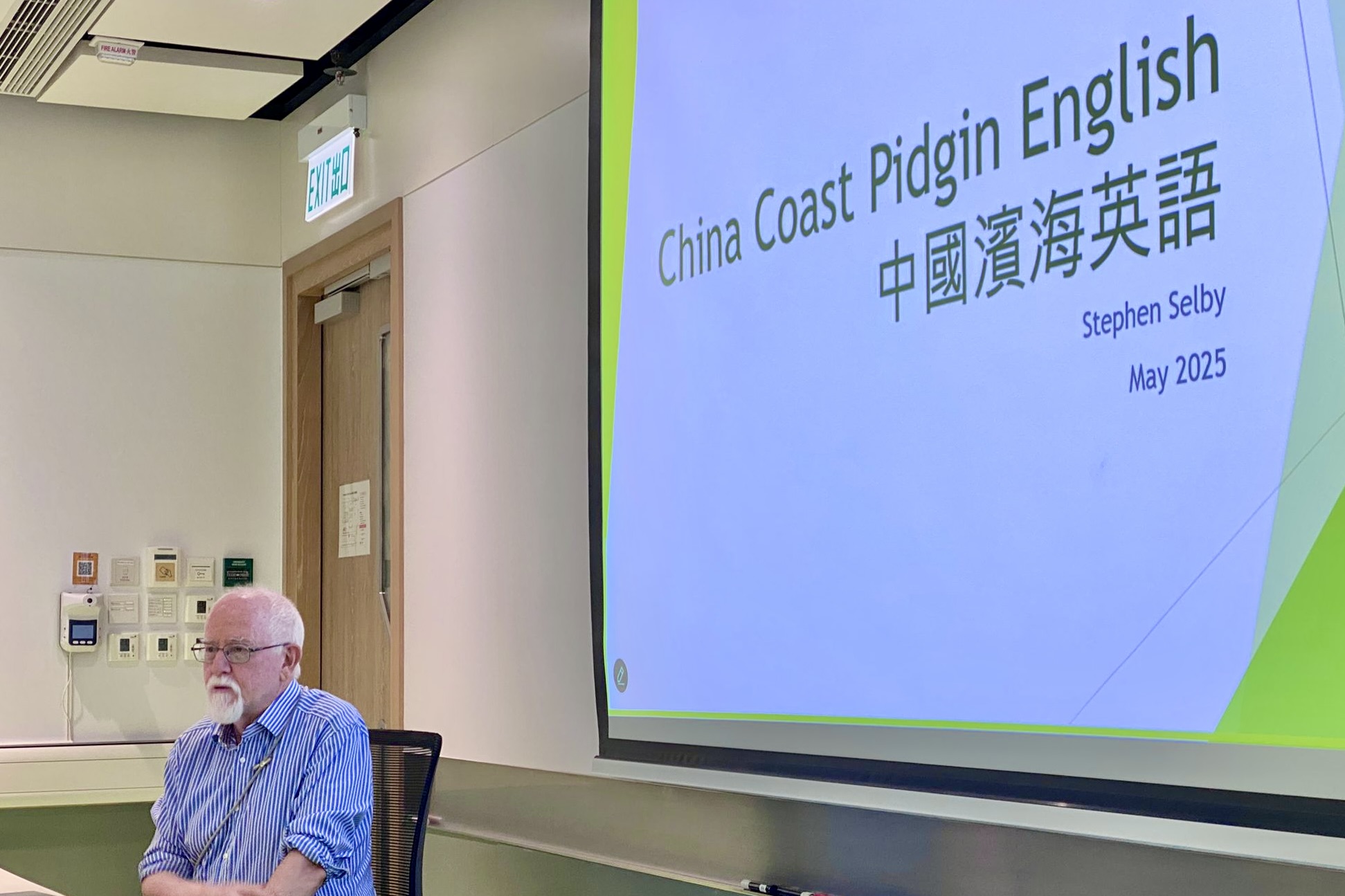
This talk traced the history of China Coast Pidgin English, a trade‑born lingua franca blending Cantonese grammar with English vocabulary. Once vital in South China, it later declined, though records reveal insights into language learning and social history. Prof Stephen Selby offered historical depth and cultural perspective on its rise, fall, and legacy.
Abstract
Pidgin English is a simplified form of English that emerged in the 18th century to facilitate communication between Chinese individuals and English speakers along the coasts of China. Initially developed through trade interactions involving Chinese and Portuguese, it served as a means for Chinese speakers to communicate in some form of the Portuguese language at a time of Qing government restrictions on communication with Westerners. Over time, Pidgin English evolved into a distinct linguistic Lingua Franca that incorporated features of Cantonese grammar and English vocabulary tailored to mercantile and shipping contexts. By the early 20th century, Pidgin English became a common means of communication in South China, facilitating interactions among groups such as masters and servants, shoppers and vendors and business elites. However, following the Opium War and subsequent improvement in education in China, its use declined, particularly among educated individuals. It became viewed negatively as a, demeaning racist parody of Chinese speech. Although China Coast Pidgin is virtually extinct today, it can be reconstructed from 19th and 20th Century records. Studying records of Pidgin gives some insights into the English language learning process of Chinese students and the social conditions of lower class Chinese people who were in contact with foreigners in the previous two centuries.
Speaker Bio
Stephen Selby was born in London in 1951. After graduating with a Master’s degree from Edinburgh University in Chinese language and literature in 1974, he worked for a time in the Mongolian State University. In 1978, he joined the Hong Kong Government and has remained in Hong Kong since then. While in the Government, he worked in the New Territories and the Finance Bureau. He spent the last 16 years of his government career as Director of Intellectual Property. He has published widely in the fields of Chinese culture and history. His research has covered Chinese traditional land law, the history of Chinese archery, the study of the Chinese writing system, and intellectual property. He presently holds posts as adjunct Professor at the Hong Kong Polytechnic University and also at the East China Normal University of Shanghai.
Gallery